Sigma Rules
Overview
Sigma rules reach the review queue through two provenance-distinct paths. Complete publisher-authored rules are imported directly from article text without an LLM and retain exact YAML and source evidence. Generated rules are created by the workflow's Sigma agent, validated with pySigma, and scored for behavioral novelty against the indexed SigmaHQ repository before human review.
See the source-provided Sigma import contract for the fidelity, provenance, immutability, and delivery-policy guarantees.
Four capabilities work together:
- Source rule import: A deterministic scanner preserves complete Sigma mappings
directly from
articles.content, records provenance and license evidence, and applies the destination repository's delivery policy. - Rule generation: LLM produces Sigma YAML from extracted observables; pySigma validates the output.
- Rule matching: Articles are matched to the indexed rule corpus (SigmaHQ plus your customer repo, if indexed) using behavioral overlap scoring to determine coverage status.
- Similarity search: Generated rules are compared against the same indexed corpus to detect duplication and classify novelty.
These last two are distinct pipelines with different inputs and scoring
mechanisms. Rule matching is article-centric — it asks whether an existing
rule already covers the behaviors described in a CTI article. Similarity search
is rule-centric — it asks whether a newly generated Sigma rule is
behaviorally novel relative to what is already indexed. Both query the same
sigma_rules table, so customer repo rules participate in both once indexed.
Your rules are not included by default
SigmaHQ rules are indexed automatically during setup. Rules from your own approved repo are not — you must index them manually and re-run whenever the repo changes:
Until you do, coverage classification and similarity search only compare
against the SigmaHQ corpus. Run sigma stats to confirm how many customer
rules are currently indexed.
System Flow
Sigma rule processing has a single workflow entry path with two internal provenance paths:
- Agentic Workflow: Triggered via
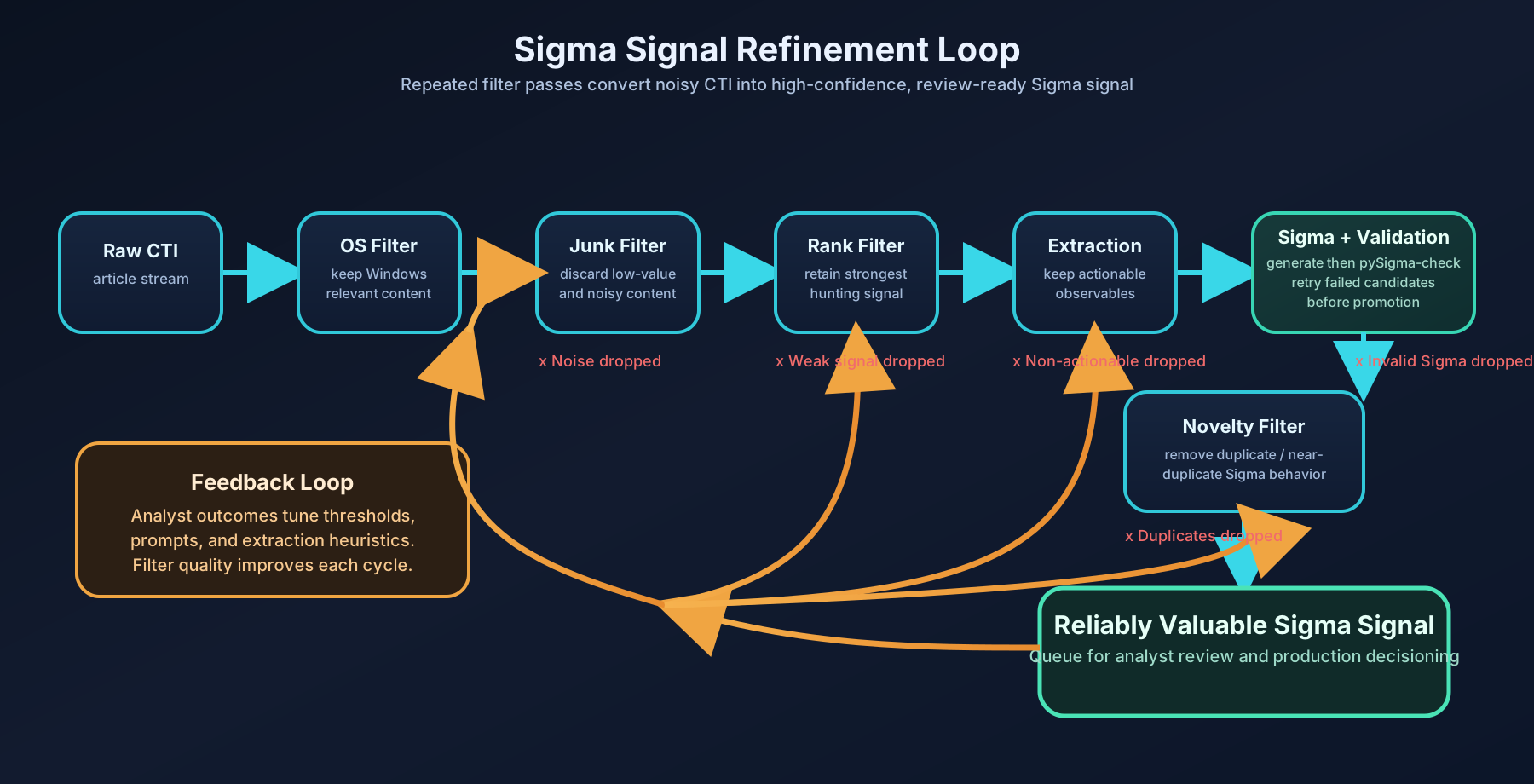
POST /api/workflow/articles/{id}/trigger- deterministic source-Sigma import -> Platform Detection -> Junk Filter -> Rank -> Extract -> Generate Sigma -> Similarity Search -> Promote to Queue. Source-provided rules bypass generation and intra-batch deduplication; generated rules continue through the existing path.
A second, manual path (POST /api/articles/{article_id}/generate-sigma) existed until it was
removed; it had no UI caller, and its rules were returned to the caller rather than queued for
review. Generation now happens only inside the workflow.
Signal Refinement Loop
Rule Generation
Process
- Content and extracted observables are passed to the Sigma generation LLM.
- The LLM produces Sigma YAML with an additional
observables_usedfield (not a valid Sigma field — stripped before pySigma validation). - pySigma validates the rule; if it fails, the error is injected into the next prompt and the LLM retries. Maximum 3 attempts.
- The final rule and full attempt log are stored in
agentic_workflow_executions.sigma_results.
Generation uses temperature 0.2 for deterministic output.
Iterative Retry
- Up to 3 attempts per rule set (initial generation)
- Validation errors from pySigma are fed back into the next prompt
- All attempt logs (prompts, responses, validation results) are stored for post-mortem review
SigmaHQ Blocking Validators
After pySigma parses a rule, validate_sigma_rule runs the same validator set the
Huntable-SIGMA-Rules CI treats as blocking (src/services/sigma_validation_blocking.yml, a
mirror of that repository's .sigma/validation-blocking.yml, executed with
pySigma-validators-sigmahq). Field names must exist in the SigmaHQ taxonomy for the
logsource, the category/product pair must be a known logsource, service: sysmon needs an
EventID, id/status/level/description must be present, and non-Sigma top-level keys
fail -- except the pipeline's own grounding keys (SIGMA_GROUNDING_METADATA_FIELDS), which
are stripped before publication. Each issue is an error prefixed SigmaHQ <Issue> and the
full list is in metadata["sigmahq"]["issues"]; when the plugin is not installed the layer
reports metadata["sigmahq"]["available"] == False and validation falls back to pySigma
plus the policy pass. Keep the YAML in step with the rules repository so a queue-approved rule
cannot fail the PR check.
ATT&CK Tag Validation
After pySigma accepts a rule, the Huntable policy pass (SigmaValidator in
src/services/sigma_validator.py) checks every attack.* tag against a cached copy of
the MITRE ATT&CK taxonomy (config/attack_taxonomy.json, loaded once by
src/services/attack_taxonomy.py; no network call at validation time).
- Errors (rule fails, goes to the repair pass): a technique, sub-technique, group,
software, mitigation, or campaign ID that does not exist, was revoked, or is deprecated.
Revoked IDs name their replacement, for example
Tag 'attack.t1086' references revoked ATT&CK technique T1086 (PowerShell); it was
  replaced by T1059.001 (PowerShell) -- use 'attack.t1059.001'
. An unknown sub-technique names its existing parent. - Warnings only: an unrecognized tactic name (
attack.persistance). The Sigma tag taxonomy lags MITRE -- ATT&CK v19 renamed Enterprisedefense-evasion, which SigmaHQ still uses -- so tactic names never fail a rule. - Tags outside the
attack.namespace (cve.*,detection.*,car.*) are not checked. - A missing or unreadable taxonomy file disables the check with one logged warning rather than failing every rule.
The taxonomy covers the Enterprise, Mobile, and ICS domains. Regenerate it when MITRE ships a new ATT&CK release (roughly twice a year) and commit the result:
Repair Pass (SigmaRepair)
After the initial generation attempt, any rules that failed pySigma validation are sent through a dedicated per-rule repair loop before the result is finalized.
How it works:
- Invalid rules are collected after the generation/validation phase.
- For each invalid rule, the
SigmaRepairprompt is called with two injected values: {validation_errors}-- the list of pySigma error strings from the failed attempt{original_rule}-- the broken YAML (up to 8,000 characters,REPAIR_RULE_MAX_CHARS)- The LLM returns a corrected rule; pySigma re-validates it.
- This repeats up to
max_repair_attempts_per_ruletimes (default: 3) per rule.
Implementation: src/services/sigma_generation_service.py --
SigmaGenerationService._repair_rules()
Prompt source: src/prompts/sigma_repair_single.txt (seed default). The
live prompt is stored in the database under the SigmaRepair key in the
workflow config's agent_prompts and can be edited in Settings -> Workflow
Config -> SigmaRepair. The DB value takes precedence over the seed file at
runtime.
Conversation Log Display
The article UI renders the LLM ↔ pySigma conversation:
- One card per attempt with pass/fail indicator
- Collapsible prompt and response blocks
- pySigma error detail when a rule fails validation
Prerequisites
- AI model configured (OpenAI API key, or LMStudio local server)
- pySigma installed (bundled in requirements)
- For article-to-rule matching (pgvector path): Sigma rules indexed (
sigma index-metadatathensigma index-embeddings). Note: the rule novelty/deduplication path uses Jaccard×Containment scoring and does not require embeddings — onlysigma index-metadatais needed for it. - Threat hunting score < 65 shows a warning but does not block generation
Platform-Aware Generation
Sigma generation runs per platform/logsource group derived from observable-level platform
and telemetry metadata (platform, telemetry_category, logsource_hint). The
ExtractAgent supervisor tags each observable with these fields during aggregation;
SigmaGenerationService groups them and runs a separate generation pass per group.
Platform routing:
| Platform | Behavior |
|---|---|
windows |
Standard generation; existing Windows-tuned base prompt applies. |
linux |
Generates Sigma. An additive Linux guidance block (LINUX_SIGMA_GUIDANCE) is appended to the generation prompt, steering toward Linux process_creation fields (Image, CommandLine, ParentImage), behavior-specific multi-condition detections, and Linux ATT&CK tags (T1059.004, T1222.002, T1053.003, T1105, T1543.002). Linux rules join the shared review queue with a linux platform badge. |
macos |
No Sigma generated, even under the full-content fallback. macOS telemetry coverage is deferred; the workflow records a structured skip for this platform. |
Linux guidance rationale: The base Sigma prompt is Windows-tuned. Without guidance, Linux
rules tended to produce over-broad single-token selections (e.g. CommandLine|contains: /tmp)
that match almost every command. The injected guidance block requires multi-condition detections
keyed on the described behavior -- for example, a chmod 777 rule must key on both the binary
(Image|endswith: '/chmod') and the mode/target, not a bare directory token.
Rule metadata: Each generated rule carries generation_basis and detection_readiness
metadata derived from the grounded observables and the rule's logsource block. These fields
are exposed in the Workflow Execution review API and the Sigma Queue UI.
Implementation: src/services/sigma_generation_service.py --
LINUX_SIGMA_GUIDANCE, _platform_sigma_guidance(), _rule_grounding_metadata().
Rule Matching Pipeline
A three-layer pipeline matches CTI articles to existing Sigma rules from SigmaHQ, classifies coverage, and gates new rule generation.
Architecture Components
Database Schema
sigma_rules — stores indexed SigmaHQ rules:
- 768-dimensional pgvector embeddings (intfloat/e5-base-v2)
- JSONB fields for logsource and detection logic
- Full metadata: tags, level, status, author, references
- Source tracking: file_path, repo_commit_sha
- Canonical fields: logsource_key, canonical_class (precomputed for novelty scoring)
Similarity results are persisted with each workflow execution in
agentic_workflow_executions.similarity_results. Promoted candidates retain
their review evidence in sigma_rule_queue, including similarity_scores,
max_similarity, behavioral_matches_found, and total_candidates_evaluated.
Sigma Sync Service
File: src/services/sigma_sync_service.py
Clones/pulls the SigmaHQ repository, parses YAML rule files, generates embeddings, and batch-indexes rules. Incremental updates only index new rules.
Key methods: clone_or_pull_repository(), find_rule_files(),
parse_rule_file(), index_metadata(), index_embeddings(), index_rules()
Sigma Matching Service
File: src/services/sigma_matching_service.py
- Article-level and chunk-level semantic search using pgvector cosine similarity for candidate retrieval
- Behavioral novelty scoring for final similarity assessment (see Novelty Service Architecture)
- Configurable candidate retrieval limits and matching threshold
Coverage Classification Service
File: src/services/sigma_coverage_service.py
Extracts behaviors from chunk_analysis_results, compares them to rule
detection patterns, and classifies each match. The underlying query has no
source filter, so customer repo rules (prefix cust-) are candidates alongside
SigmaHQ rules whenever they have been indexed — see
Customer Repo Rules.
| Status | Condition |
|---|---|
covered |
Similarity ≥ 0.85 and behavior overlap ≥ 0.7 |
extend |
Similarity ≥ 0.7 and overlap ≥ 0.3 |
new |
Low overlap — new detection opportunity |
Enhanced Generation Workflow
File: src/web/routes/ai.py
- Match article to existing rules (threshold 0.7)
- Classify each match (
covered/extend/new) - Store matches to database
- If ≥ 2 rules are
covered: skip generation, return matches - Otherwise: proceed with LLM generation
Embedding Strategy
All Sigma embedding operations use intfloat/e5-base-v2 via local
sentence-transformers (768 dimensions). Article embeddings already stored in
articles.embedding are reused; chunk embeddings are generated on-demand from
chunk_analysis_results. Rule embeddings combine title + description +
logsource + tags.
Similarity Search
Compares generated rules against indexed SigmaHQ rules to detect duplication and score novelty.
How It Works
Generated Rule
  1. Extract detection atoms via sigma_similarity (live or index-time precompute)
  2. Phase 1 candidate retrieval — two paths:
       (a) canonical_class path: filter sigma_rules.canonical_class = X (no LIMIT)
       (b) logsource_key fallback: filter sigma_rules.logsource_key = X (LIMIT 20)
     Each candidate is tagged with the phase1_path it came from.
     Both paths, and the exact-hash shortcut before them, skip the rule's own
     customer-repo copy (`cust-<yaml id>`), which is byte-identical once its PR
     merges and the repo syncs.
  3. Phase 2 scoring — Jaccard × Containment − Filter over atom sets
  4. Phase 3 safety gate (scoped) — drop logsource_key mismatches ONLY on the
     logsource_key-fallback path. The canonical_class path's SQL filter is the
     authoritative scoping; gating it would re-impose the narrower predicate the
     canonical_class column was created to escape (Spec Item 6, Option B per
     2026-06-01 4c measurement).
  5. Return top matches above threshold, sorted by similarity descending
Step 1 extracts atoms from all three Sigma selection shapes:
| Shape | Example | Atom production |
|---|---|---|
| Single map | selection: { Image\|endswith: '\foo.exe' } |
Field-bearing atom per field/value pair |
| List of maps | selection: [{...}, {...}] |
Implicit OR of indicator sets; each map produces field-bearing atoms |
| List of scalars | keywords: ['<script>', 'onerror='] (or any selection name) |
Field-less keyword atom per scalar — field="", op="contains", polarity derived from the condition (not <key> → negative; otherwise positive) |
Mixed lists (dicts and scalars in the same list — rare but legal) split across the second and third paths.
Atom-less rules → NOVEL. If no detection atoms can be extracted — i.e., truly
degenerate cases like a selection with an empty dict (selection: {}) or detection
shapes the extractor doesn't model at all — the rule has no behavioral fingerprint
to compare. Rather than risk a false DUPLICATE (an empty canonical form would
hash to one shared exact_hash across every such rule), generate_exact_hash
returns None (leaving the DB column NULL so SQL IS NULL semantics prevent any
match) and assess_novelty short-circuits to NOVEL. The two guards compose:
the hash-side guard closes the upstream root cause; the assess-side guard is
defense-in-depth. In the current live corpus, every indexed rule produces atoms
and a distinct exact_hash — the atom-less population is 0 — but the guards stay
in place for malformed or unmodeled rules that may arrive in the future.
Behavioral Novelty Scoring
Precomputed atom path (stored atom columns are available):
novelty_score = 1 - similarity_score
similarity_score = (atom_jaccard × containment) − filter_penalty
Where:
- atom_jaccard = |atoms(A) ∩ atoms(B)| / |atoms(A) ∪ atoms(B)|
- containment = a categorical factor B ∈ {1.0, 0.85, 0.75, 0.65} expressing how
far one rule's atoms subsume the other's. It is not a raw ratio; it is bucketed
from overlap_ratio_a, overlap_ratio_b, and surface_ratio (see below).
- filter_penalty = reduction when one rule's filters would exclude the other's detection
The intermediate ratios fed into containment:
overlap_ratio_a = |intersection| / |atoms(A)|
overlap_ratio_b = |intersection| / |atoms(B)|
surface_ratio   = |surface(A) − surface(B)| / max(surface(A), surface(B))
The bucket (containment_factor shown in the UI as "Containment") is selected by:
| Bucket | Condition | B |
|---|---|---|
| Equivalent | overlap_a ≥ 0.9 and overlap_b ≥ 0.9 and surface_ratio ≤ 0.10 |
1.00 |
| Subset (A ⊂ B) | overlap_a ≥ 0.9 and surface(A) < surface(B) |
0.85 |
| Superset (A ⊃ B) | overlap_b ≥ 0.9 and surface(A) > surface(B) |
0.75 |
| Else (no clear subset relationship) | (default) | 0.65 |
So a 65% Containment in the UI means "neither rule is a clean ≥90% subset of the other" — the floor value, not a literal "65% of atoms overlap."
Surface (DNF branches)
surface_score = number of branches the detection has after being expanded to
Disjunctive Normal Form. Conceptually: how many distinct shapes of event can
trigger this rule?
- Every
ANDkeeps everything in one branch. - Every
OR(explicitor, list of selections,1 of selection_*, list-valued selection blocks) doubles or multiplies the branches.
Code: sigma_atom_similarity/sigma_similarity/surface_estimator.py.
Worked example
Two rules that both involve php.exe:
Rule A — PowerShell Spawning PHP (surface = 1):
detection:
  selection_parent:
    ParentImage|endswith: \powershell.exe
  selection_image:
    Image|endswith: \php.exe
  selection_cli:
    CommandLine|contains|all:
      - \AppData\Roaming\php\
      - -d extension=zip
  condition: selection_parent and selection_image and selection_cli
Pure AND of three selections → one way to satisfy it → surface = 1.
Rule B — Php Inline Command Execution (surface = 2):
detection:
  selection_cli:
    CommandLine|contains: " -r"
  selection_img:
    - Image|endswith: \php.exe          # branch A
    - OriginalFileName: php.exe         # branch B
  condition: all of selection_*
The list under selection_img is implicit OR. After DNF expansion:
(cli ∧ Image=\php.exe) OR (cli ∧ OriginalFileName=php.exe) → two ways to
satisfy it → surface = 2.
Why it's displayed alongside Jaccard and Containment
Surface is the denominator behind the Subset / Superset buckets in containment. A 1-branch rule whose atoms are ≥90% inside a 2-branch rule earns Subset (B = 0.85), which is a stronger signal than the atom counts alone would suggest: "every event this narrower rule fires on, the broader rule could also fire on via one of its branches." High Containment + low Jaccard + asymmetric Surface is the classic narrow-rule-inside-broader-rule pattern — not a duplicate, but the broader rule already covers your behavior.
If Surface ever looks wildly off (e.g. dozens of branches for a simple-looking
rule), it usually means a nested 1 of / wildcard selection-name pattern blew
up the DNF, which feeds back into a noisy Containment score. Surface is also
the trigger for the dnf_expansion_limit reason flag, which short-circuits the
comparison to "Skipped (unsupported rule type)" in the UI.
Cross-field soft matching: When strict atom intersection is empty, value-based
soft matching applies across process-executable fields (Image, CommandLine,
ParentImage, ParentCommandLine, OriginalFileName, and their canonical
process.* variants). Same executable value in different fields awards
50%-dampened partial Jaccard credit, preventing 0% similarity between rules
detecting the same binary via different Sigma fields.
When atom extraction runs
SigmaNoveltyService.assess_novelty uses a single scorer (compare_precomputed_atoms)
over atom sets from the sigma_similarity package. The in-app YAML re-parse scorer
(atom Jaccard 70% + logic shape 30%) was retired in 2026-06-10.
| Stage | Function | require_canonical_class |
Purpose |
|---|---|---|---|
| Index / backfill | precompute_atom_fields() |
True (strict) |
Store canonical_class, positive_atoms, negative_atoms, surface_score only for explicitly modeled telemetry classes |
| Comparison (proposed rule) | extract_atom_fields() |
False |
Live atom extraction even when canonical_class is unresolved |
| Comparison (candidate w/o stored atoms) | extract_atom_fields() |
False |
Same live extraction for corpus rows missing precomputed columns |
For each (proposed, candidate) pair:
- Proposed rule atoms come from
extract_atom_fields(proposed_rule, require_canonical_class=False). - If the candidate has stored
positive_atoms, compare against those. - Else, live-extract the candidate the same way.
- If either side cannot produce atoms, the candidate is skipped (no second-engine fallback).
sigma_atom_similarity must be installed at runtime (Docker image includes it). Without it, novelty assessment cannot score behavioral similarity.
Canonical-class coverage (index-time gate; comparison-time extraction may still produce atoms with canonical_class=None):
- Modeled:
process_creation(windows/linux/macos); registry family; Windows file family; Sysmon-EID categories (image_load,network_connection,process_access,create_remote_thread,driver_load,create_stream_hash,pipe_created,dns_query); PowerShell (ps_script,ps_module,ps_classic_start);web.webserver,web.proxy,network.dns;windows.service,windows.scheduled_task. - Keyword-list selections (XSS/SSTI/Log4j webserver rules) are modeled on both index and live paths (Conditional B, 2026-06-02).
- Still unmodeled (Coverage-Chain backlog): cloud/audit telemetry, heterogeneous multi-EID services,
linux.file_event,macos.file_event, assorted singletons.EventCodeis treated asEventID.
Rules whose Sigma syntax exceeds the AST builder (unsupported correlation, DNF expansion limit) return None from extraction and are skipped. The DNF cost guard is exactly 64 branches: a rule that would expand to more than 64 branches is deliberately not atomized. Large value enumerations can hit that guard because they normalize into OR branches; raw detection length is a symptom, not a separate threshold.
The index/backfill path deliberately leaves all four atom fields unset for two common cases: an unresolved canonical telemetry class (including product-only logsources such as product: azure or bare product: windows) and the DNF expansion limit. This is not evidence that the rule was never indexed; canonical_json remains available. The schema does not record a per-rule skip reason, so distinguish those intentional outcomes from unexpected failures with the precompute logs or a sigma recompute-atoms run.
Code labels: similarity_engine: "precomputed" means stored atom columns were used; "on-the-fly" means live atom extraction was used because stored atoms were unavailable. Historical rows with the old labels are mapped on read.
Similarity Thresholds
| Range | Interpretation |
|---|---|
| > 0.9 | Consider using existing rule instead |
| 0.7 – 0.9 | Review for potential extension |
| < 0.7 | Novel detection opportunity |
Queue Status: needs_review
When candidates are evaluated but zero behavioral matches are found (i.e., the Jaccard×Containment
scorer returned no non-zero results), the outcome is inconclusive — not confidently novel.
Previously this was collapsed into max_similarity=0.0 and treated as novel; it is now a
distinct queue state.
needs_review(yellow badge): candidates were evaluated, none produced a behavioral match.max_similarityis stored asNULL;behavioral_matches_found=0withtotal_candidates_evaluated > 0. Queue actions: Approve or Reject.pending(standard): a scored similarity result exists (possibly 0.0 from an empty corpus or a genuinely low score).max_similarityis a numeric value.
Two DB columns on sigma_rule_queue support this: behavioral_matches_found and
total_candidates_evaluated.
Candidate Retrieval
The /api/sigma-queue/{id}/similar-rules response includes
total_candidates_evaluated, canonical_class, and logsource_key so the UI
can explain why the candidate count may be lower than the total indexed rules.
Customer Repo Rules
Similarity search uses the single sigma_rules table. To include approved rules
from your customer repo alongside SigmaHQ rules:
# Index approved rules from customer repo (metadata + embeddings)
./run_cli.sh sigma index-customer-repo

# Metadata only (embeddings later)
./run_cli.sh sigma index-customer-repo --no-embeddings
Customer rules use rule_id prefix cust- and file_path prefix cust/. Queued rules are
never scored against their own customer copy (cust- + the rule's YAML id), so a merged,
synced rule still surfaces real duplicates instead of a 1.0 self-match.
Sigma Queue
Rules that pass generation and similarity scoring are placed in the Sigma Queue for human review before being submitted to your GitHub Sigma rules repository.
Queue Status Lifecycle
[generated] ──► pending        ──► approved ──► submitted
                                └► rejected
             ──► needs_review  ──► approved ──► submitted
                                └► rejected
| Status | Badge | Meaning |
|---|---|---|
pending |
grey | Scored rule awaiting review; similarity comparator produced a confident result (including a confident zero when the corpus is empty) |
needs_review |
yellow | Comparator was inconclusive — candidates were evaluated but none produced behavioral matches; similarity is unscored (max_similarity = null) |
approved |
green | Human accepted the rule; eligible for GitHub PR submission |
rejected |
red | Human discarded the rule |
submitted |
blue | Rule has been submitted to the GitHub repository as a PR |
Once a rule is submitted (pr_submitted or submitted_at set), its rule_yaml is the record of
what went to the repository and is read-only: the approve, reject and PUT /api/sigma-queue/{queue_id}/yaml
endpoints return 409 for any YAML change (re-sending identical YAML is allowed). To revise a
submitted rule, add an edited copy to the queue. Every accepted YAML edit also refreshes
rule_metadata.title, which drives the queue's header title.
needs_review in Depth
needs_review is set when the behavioral novelty comparator finds candidates in
the indexed corpus (i.e. total_candidates_evaluated > 0) but produces zero
behavioral matches (behavioral_matches_found == 0). This is not the same as
a low similarity score — it means the comparator could not confidently assert the
rule is novel or redundant.
Why this matters: Before needs_review existed, this inconclusive outcome was
collapsed into max_similarity = 0.0, which appeared identical to a confident
"no overlap" score. The result was that ~86% of queued rules were silently treated
as novel and novelty-suppression logic never fired.
When it occurs:
- The rule's logsource/canonical-class filter found candidates in the corpus.
- Atom extraction succeeded on both sides.
- But no atom from the generated rule matched any atom in any candidate — either due to field-name mismatches, normalization gaps, or genuinely orthogonal detection logic.
What is stored:
| Column | Value |
|---|---|
max_similarity |
null (unscored; None in Python) |
behavioral_matches_found |
0 |
total_candidates_evaluated |
N > 0 |
Empty corpus is different: when total_candidates_evaluated == 0 (no rules
indexed for this logsource), the result is a confident zero similarity, not
inconclusive. That rule enters pending, not needs_review.
Implementation: summarize_rule_novelty() in
src/workflows/agentic_workflow.py:683 encodes this three-way distinction. The
list endpoint (GET /api/sigma-queue/list) re-runs the check on-the-fly for pending
rows that lack evidence columns, then skips rows that already have evidence set
to prevent thrash.
Reviewing needs_review Rules
In the Sigma Queue UI, needs_review rows show:
- A yellow Needs Review badge.
- The
total_candidates_evaluatedcount (how many corpus rules were compared). behavioral_matches_found: 0as the reason for inconclusive status.- Approve and Reject action buttons — same as
pendingrows.
Recommended review steps:
- Open the full rule YAML and inspect the
detectionblock. - Check the Similar Rules panel to see which candidates were retrieved — the logsource filter matched these rules but atom extraction found no overlap.
- If the rule detects genuinely novel behavior, Approve it.
- If the rule is a near-duplicate that the comparator missed (e.g. equivalent field names the normalizer does not yet know about), Reject it and open an issue for the missing alias.
API Reference
List Queue
GET /api/sigma-queue/list
Optional query params: ?status=needs_review (or pending, approved,
rejected, submitted), ?workflow_execution_id=<id> (narrow to one workflow
job's rules).
Response includes status_counts broken down by status and behavioral_matches_found /
total_candidates_evaluated per row.
Approve a Rule
POST /api/sigma-queue/{queue_id}/approve
Reject a Rule
POST /api/sigma-queue/{queue_id}/reject
No body required.
Bulk Actions
POST /api/sigma-queue/bulk
Valid actions: approve, reject, delete, set_status.
Observables-Used Tracing
Every LLM-generated Sigma rule carries an observables_used field linking it
back to the extracted observables it was built from.
What It Is
During generation the LLM includes a observables_used key in its YAML
alongside the valid Sigma fields:
observables_used is not a valid Sigma field — the generation service strips it
before pySigma validation and stores it in rule metadata
(SigmaGenerationResult.observables_used). An empty list means the rule was
synthesized from article context without directly referencing an extracted
observable.
Inference Fallback
If the LLM omits observables_used, _infer_observables_used() in
src/services/sigma_generation_service.py recovers it by:
- Tokenizing each observable's
valuefield into tokens ≥ 4 characters - Checking whether any token appears as a substring in the rule's
detectionblock - Returning indices of matching observables, or
Noneif none match
When recovered via inference, observables_used_inferred: true is set in rule
metadata.
Storage
After generation the field is stored in rule_metadata["observables_used"]
within WorkflowExecutionTable.sigma_results and propagated to the sigma_queue
entry for display in the Sigma Queue UI.
Novelty Service Architecture
| Layer | File | Role |
|---|---|---|
| Entry point | sigma_matching_service.py |
Calls SigmaNoveltyService.assess_novelty() |
| Orchestrator | sigma_novelty_service.py |
Retrieves candidates, computes Jaccard/containment/filter scores |
| Precompute | sigma_atom_precompute.py |
extract_atom_fields() / precompute_atom_fields() - materializes atom sets at index time |
| External engine | sigma_atom_similarity pkg |
Atom set-math package; used for Sigma-to-Sigma behavioral similarity |
Vocabulary: "semantic", "embedding", "vector" mean three different things here
The word "semantic" is overloaded across the Sigma code and is the single biggest source of confusion. There are three independent similarity mechanisms, and only two of them actually involve vectors:
| Mechanism | What it is | Vectors? | Where |
|---|---|---|---|
| Article / annotation semantic search | Genuine ML embeddings (all-mpnet-base-v2), cosine nearest-neighbour over article text. Powers MCP article search, RAG, web search. | Yes — real Vector(768) + <=> |
ArticleTable.embedding, AnnotationTable.embedding |
| Article→rule matching (RAG) | Given an article, find candidate rules by cosine over rule embeddings. | Yes — two vectors per rule: SigmaRuleTable.embedding (whole-rule text) and logsource_embedding (the combined "signature" text: logsource + detection structure + detection fields). Both are scored via <=>. (Five former per-section columns — title_/description_/tags_/detection_structure_/detection_fields_embedding — were write-only and were dropped 2026-06-01; detection_structure_/detection_fields_ had stored a duplicate of the signature vector.) |
sigma_matching_service.py, rag_service.py |
Behavioural novelty / dedup (the "precomputed" atom engine) |
Exact atom set-math - Jaccard x containment over canonical atom-identity strings. No vectors, no ML, no embeddings. The distribution is named sigma_atom_similarity; the import package remains sigma_similarity. |
No | sigma_atom_similarity pkg, precompute_atom_fields |
The atom set-math engine is deterministic. The distinction is when atoms are computed:
| Canonical term | Code label (similarity_scores) |
What it is |
|---|---|---|
| index-time atoms | "precomputed" |
Atoms stored in positive_atoms/etc.; comparison reads stored strings |
| live extraction | "on-the-fly" |
extract_atom_fields() at comparison time when stored atoms are absent |
| exact-hash duplicate | "precomputed" |
Short-circuit before pairwise scoring; no live extraction needed |
Neither path uses embeddings. The only probabilistic/fuzzy similarity is article and article→rule vector search (first two rows above). The active service names are precompute_atom_fields / extract_atom_fields because this path is atom extraction, not embedding work.
Label rename done (2026-06-11): the
similarity_scoresengine labels were renamed"deterministic"→"precomputed"and"legacy"→"on-the-fly"across the producers (sigma_novelty_service.py,sigma_matching_service.py), the shared serializer, andsimilarity-display.js. Rows persisted before the rename still carry the old values and are mapped on read bysimilarity_serialization.alias_engine_label()(mirrored in JS asaliasEngineLabel), so no destructivesimilarity_scoresJSONB backfill was needed. Dead rule-embedding columns were dropped 2026-06-01.
CLI Commands
File: src/cli/sigma_commands.py
# Sync SigmaHQ repository
./run_cli.sh sigma sync

# Index rules: metadata first, then embeddings
./run_cli.sh sigma index-metadata
./run_cli.sh sigma index-embeddings

# Or both at once (partial success if embeddings fail)
./run_cli.sh sigma index [--force]

# Match a single article
./run_cli.sh sigma match <article_id> [--save] [--threshold 0.7]

# Show index statistics
./run_cli.sh sigma stats

# Recompute stored atom fields (needed after atom identity normalization changes)
./run_cli.sh sigma recompute-atoms

# Backfill canonical fields for rules already in DB
./run_cli.sh sigma backfill-metadata

# Index approved rules from customer repo
./run_cli.sh sigma index-customer-repo [--no-embeddings] [--force]
Queue Statuses
Rules generated by the agentic workflow are placed in sigma_rule_queue with one of these statuses:
| Status | Meaning |
|---|---|
pending |
Novelty scored; awaiting human Approve or Reject |
needs_review |
Novelty comparison was inconclusive (candidates evaluated, 0 behavioral matches found); requires manual inspection before promoting |
approved |
Operator approved; ready for PR submission |
rejected |
Operator rejected; excluded from submission |
submitted |
PR created in customer Sigma repo |
needs_review detail: When summarize_rule_novelty() in agentic_workflow.py finds candidates were evaluated but none produced behavioral matches, max_similarity is set to None (unscored) and the queue entry is routed to needs_review instead of pending. The queue UI shows a yellow "Needs Review" badge and allows Approve/Reject actions. Evidence columns behavioral_matches_found and total_candidates_evaluated are stored on the sigma_rule_queue row for audit purposes.
API Reference
Get Existing Matches
Endpoint: POST /api/articles/{article_id}/sigma-matches
Assesses the rules queued for this article (sigma_rule_queue, excluding rejected rows) against
the indexed Sigma corpus. Returns an empty result with a message when the article has no queued
rules. Requires an indexed corpus — see Sigma Rule Embeddings.
Response:
{
  "success": true,
  "matches": [
    {
      "rule_id": "a1b2c3d4-...",
      "title": "PowerShell Suspicious Script Execution",
      "similarity": 0.875,
      "atom_jaccard": 0.82,
      "containment": 0.85,
      "coverage_status": "covered",
      "matched_discriminators": ["powershell.exe", "EncodedCommand"],
      "matched_lolbas": ["powershell.exe", "cmd.exe"],
      "created_at": "2025-01-16T10:30:00"
    }
  ],
  "coverage_summary": {"covered": 2, "extend": 1, "new": 0, "total": 3}
}
Configuration
Environment Variables
# Huntable-created rules / PR submission (customer rules repo)
SIGMA_REPO_PATH=sigma-repo
GITHUB_REPO=owner/repo
GITHUB_TOKEN=ghp_xxx       # Add in Settings -> GitHub (repo scope)

# Similarity matching threshold (CLI default)
./run_cli.sh sigma match <article_id> --threshold 0.7
GitHub PR Setup
The app uses two separate repositories:
- Customer rules repository:
../Huntable-SIGMA-Rules, mounted assigma-repo. This is the only repository used for Huntable-created rules and GitHub PRs. SetSIGMA_REPO_PATHto this repository. - SigmaHQ reference repository:
data/sigma-repo. This is a local upstream cache used bysigma syncand reference-rule indexing. Do not use it for PR submission.
PR submission refuses to operate when the configured repository's origin is SigmaHQ/sigma.
For HTTPS remotes, the GitHub PAT is supplied only to the active Git command through
an ephemeral GIT_ASKPASS helper. The token is never added to the remote URL; if a
legacy origin already contains credentials, PR submission removes them before any
fetch, pull, or push. SSH remotes continue to use SSH authentication unchanged.
- During
./setup.sh: Create a repo at github.com/new, enterowner/repowhen prompted. The script clones to../Huntable-SIGMA-Rulesand creates therules/structure. - After setup: Add your GitHub Personal Access Token in Settings → GitHub (repo scope).
- Settings → GitHub: Configure Sigma Repository Path, GitHub Repository, and Git user name/email for commits.
AI Model Configuration
| Model | Notes |
|---|---|
| OpenAI | API key is resolved server-side from Settings or environment; temperature 0.2 |
| Anthropic | API key is resolved server-side from Settings or environment; temperature 0.2 |
| LM Studio (local) | No API key; configure the model and endpoint in Settings |
| Codex subscription | Optional deployment-managed ChatGPT subscription; enable WORKFLOW_CODEX_ENABLED and select an available subscription model |
The SIGMA queue enrichment modal uses the selected provider and model for rule revisions. After a successful enrichment, Start Chat replays the rule-scoped transcript with that same provider. The follow-up chat is limited to revising the current rule and discussing earlier enrichment turns; it does not perform unrelated research or external actions.
Sigma Rule Embeddings
Indexing uses intfloat/e5-base-v2 via local sentence-transformers (no LMStudio
required). Run sigma index-metadata first, then sigma index-embeddings to
enable similarity search. The SigmaEmbeddingModel workflow config key is
retained for import/export fidelity only. LM Studio is not an embedding backend;
the obsolete LMSTUDIO_EMBEDDING_MODEL setting and dead client plumbing have
been removed. The active embedding model is hardcoded to intfloat/e5-base-v2.
Each rule stores two Vector(768) embeddings: embedding (whole-rule text)
and logsource_embedding (the combined "signature" — logsource + detection
structure + detection fields, built by create_signature_embedding_text). Only
these two are scored by the article→rule matching path. index-embeddings
therefore encodes two texts per rule. (The deprecated
scripts/migrate_sigma_embeddings.py predates this and is non-functional — use
sigma index-embeddings.)
Troubleshooting
No Similarity Results
- Ensure Sigma rules are synced and indexed:
- If rules were indexed before
logsource_keyexisted, backfill canonical fields: - Check index status:
- If similarity is still zero, atom identity normalization may be stale. LLM-generated rules may use lowercase/snake_case field names that don't match PascalCase atoms in SigmaHQ rules. Recompute: See Sigma Similarity Case-Sensitive Atom Matching.
Embedding Generation Failures
sentence-transformers not installed: ensure it is in requirements- Out of memory:
intfloat/e5-base-v2loads on first use; ensure sufficient RAM - Run
sigma index-metadatabeforesigma index-embeddings
pySigma Validation Failures
- Check rule format compliance; review the conversation log for per-attempt error detail
- Common issues: missing required fields (title, logsource, detection), invalid YAML, incorrect metadata types, unknown field modifiers, malformed or undefined detection conditions, and Huntable grounding or quality-policy failures
references unknown/revoked/deprecated ATT&CK ...: the rule cites a MITRE ATT&CK ID that is not current (see ATT&CK Tag Validation); the error names the replacement when MITRE recorded one. If the taxonomy itself is stale, regenerateconfig/attack_taxonomy.jsonwithscripts/build_attack_taxonomy.py
Slow Performance
- Rebuild the vector index:
- Adjust HNSW
m/ef_constructionparameters (the index is HNSW, not IVFFlat -- seescripts/migrate_pgvector_indexes.py) - Increase database resources
Debug Commands
LOG_LEVEL=DEBUG
docker compose logs -f web | grep "SIGMA"
docker compose exec web python3 -c "from src.services.embedding_service import EmbeddingService; print('OK')"
References
- SigmaHQ Repository
- Sigma Specification
- pgvector
- Sentence Transformers
- pySigma Documentation
- CLI Reference
- Sigma Similarity Case-Sensitive Atom Matching
- Sigma Cross-Field Soft Matching
Last updated: 2026-08-13